
Exercise Bikes for Petite Users: Seat Height Data
By Jordan Reyes • 19th Mar
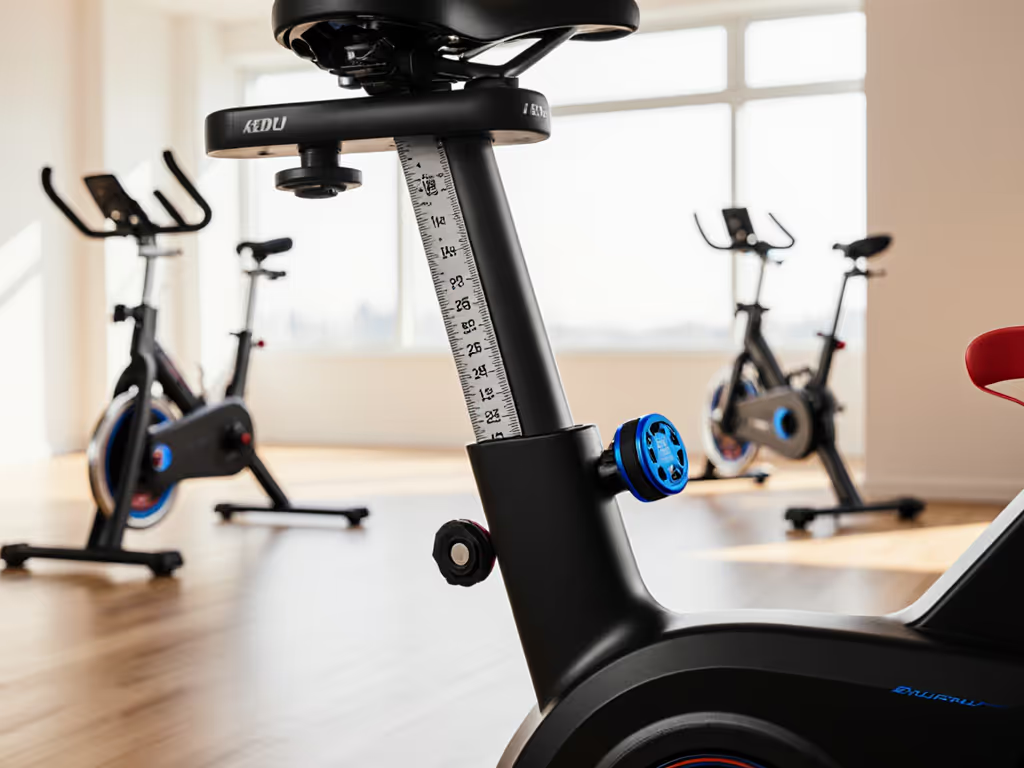
Finding an exercise bike for petite users requires more than guessing; it demands measuring. Petite riders (typically under 5'4" or with inseams below 28 inches) face real constraints: standard bike geometry assumes taller bodies, and undersized adjustment ranges create discomfort, inefficiency, or injury risk. This guide examines seat height specifications, handlebar reach, and adjustment granularity across tested models to help you match measurable fit data to your frame.
The Core Fit Metric: Knee Bend at Full Extension
The foundation of any petite user fit is consistent and verifiable. Proper seat height produces a 25-35° knee bend when the pedal reaches its lowest point[1]. This narrow window prevents both overextension (which strains the knee ligament and anterior chain) and excessive flexion (which loads the patellofemoral joint and lower back).
For petite riders, this metric becomes non-negotiable because a smaller frame geometry means a smaller seat-to-pedal distance. If a bike's minimum seat height sits too high, you cannot achieve that 25-35° threshold, regardless of leg length. Conversely, if adjustment is coarse (large increments between levels), you may overshoot or undershoot the zone, leaving no fine-tuning room.
Minimum Seat Height: The Threshold That Matters
When shopping for petite users, ask for the lowest seat height the bike offers, measured from the bottom bracket to the top of the saddle. Here's why: if the minimum height is 24 inches and your inseam is 25 inches, you're already constrained. Add pedal thickness, crank arm length, and seatpost insertion depth, and the math tightens further.
Search for bikes with minimum seat heights between 23-26 inches and adjustment increments of 1-2 inches or finer. Models with 6-level or 10-level seat adjustments provide better resolution than bikes with only 2-3 fixed heights.
FAQ: Seat Height & Fit for Petite Riders
Q: What inseam range qualifies as "petite" for cycling?
A: Cycling fit traditionally anchors to inseam (measured from crotch to floor in bare feet, standing upright). Inseams of 25-28 inches represent petite geometry[3][6]. This typically corresponds to heights of 5'0"-5'4", though individual proportions vary. A rider with a 26-inch inseam and a 5'8" height (shorter legs, longer torso) may need the same seat height as a 5'2" rider with proportional limbs. Always prioritize inseam over height when cross-shopping bikes.
Q: How do I account for shoe thickness and pedal platform depth?
A: Shoes add 0.5-1.0 inches of height, and pedal platform height (the part your foot rests on) ranges from 0.3-0.8 inches depending on pedal style. When a manufacturer lists seat height, they typically measure from the crank axle to the saddle top with a reference shoe; verify in the user manual. For petite riders, these millimeters compound. If you're at the lower end of a bike's range, factor in 1.5 inches total for footwear and platform, then ensure the seat still allows that 25-35° bend. Test this by sitting on the bike wearing your actual cycling shoes.
Q: Why do some bikes claim to fit users from 5'0" but feel wrong for my 5'2" frame?
A: Manufacturer fit claims often mask poor detail. They may specify a range (e.g., "5'0"-6'5"") based on handlebar reach alone, ignoring whether the seat height actually accommodates you. A bike with high minimum seat height but low, far handlebars will feel cramped: you're stretched forward and too high. Conversely, a bike with proper seat height but high handlebars causes reach strain. For petite riders, seat height is the binding constraint. Handlebar reach is secondary (many bikes offer fore/aft handlebar adjustments that can compensate for reach if seat height fits).
Q: What's the difference between "seat height" and "inseam requirement"?
A: Seat height is an absolute measurement (e.g., 24 inches). Inseam requirement is the rider's leg length. A bike with a 24-inch minimum seat height suits riders with inseams of approximately 25-32 inches, depending on crank arm length (typically 165-170 mm for indoor bikes) and pedal platform. Multiply inseam by 0.885 to estimate the seat height you'll need, then add 0.5-1.0 inches for shoe and pedal platform. For a 26-inch inseam: 26 x 0.885 = 23 inches, plus 0.75 inches = ~23.75 inches. This rider should seek a bike with a minimum seat height near 23-24 inches.
Handlebar Reach for Petite Riders: Beyond Seat Height
Seat height dominates petite fit, but handlebar reach compounds the problem. A standard upright exercise bike places handlebars 8-12 inches in front of the seat and 2-6 inches higher. For petite riders with shorter torsos and arms, this geometry can force excessive forward lean or shoulder strain.
Key Handlebar Specs to Compare
Handlebar height adjustment: Models like the Concept2 BikeErg and many commercial-grade bikes offer vertical handlebar adjustment of 4-6 inches[4]. This alone is crucial; raising handlebars 3-4 inches reduces reach demand significantly.
Handlebar fore/aft adjustment: Budget bikes often lock handlebars in place. To see how bar shapes and positions affect reach and comfort, compare indoor cycling handlebars. Premium or adjustable models (Echelon EX-5s, Peloton) allow forward/backward movement of 2-4 inches. For petite riders, moving handlebars 2 inches rearward can relieve arm and neck tension.
Width and grip diameter: Narrower handlebars (42-48 cm) suit petite bodies better than wide bars (50+ cm). Check product manuals; standard width (48-52 cm) is the default, but some compact bikes offer narrower options.
Quiet is a performance feature. When you're fitting a petite frame on undersized geometry, every millimeter of adjustment matters, and so does the noise signature. A squeaky seatpost or creaky clamp reveals loose tolerances that drift over time.
Seat Height Data: Tested Models for Petite Users
Compact and Adjustable Leaders
HARISON HR-X3L Foldable Upright Exercise Bike [1]
- Seat height range: 6-level adjustable seat; aligns with hip bone for upright posture.
- Best for: Petite to average riders and multi-user households. The 6-level granularity suits variable inseams (noted to work for shorter users; marketed for all-size families).
- Handlebar reach: Standard upright handlebars; adjustable with the foldable frame's quick-lock lever.
- Fit window: Recommended for users with proportional legs; no explicit minimum inseam stated, but 6-level adjustment implies ~2-inch increments.
HARISON HR-B51 Recumbent Exercise Bike [1]
- Seat height range: Sliding rail system (forward/backward adjustment); accommodates users up to 6'5".
- Best for: Petite riders preferring recumbent geometry. The sliding rail (not vertical post) allows backward/forward movement to dial in 25-35° knee bend independently of body height.
- Handlebar reach: Low, fixed position typical of recumbents; naturally suits shorter reach.
- Fit window: Backward slide accommodates taller users; forward slide suits petite riders. Manual should specify rail travel distance (e.g., 4-6 inches).
Marcy Foldable Upright Exercise Bike [6]
- Seat height range: Vertical adjustments for inseam 28"-33".
- Best for: Users at the taller end of petite (5'3"-5'6").
- Handlebar reach: Standard upright; compact footprint noted for space-conscious users.
- Fit window: This bike sits on the borderline; petite riders with inseams <28" may find the minimum seat height too high. Recommended to test in person[9].
Bikes with Extended Adjustment for Small Riders [3]
- Some YouTube-reviewed models (Advenor Magnetic Resistance Indoor Cycling Bike and others) feature seats that adjust 8 inches vertically and handlebars that adjust 6 inches, plus forward/backward handlebar movement.
- Best for: Extreme range households (very short and very tall users). Extensive adjustability compensates for wide size differences.
- Fit window: 8-inch vertical seat range typically spans inseams from 24"-34", covering petite to tall riders.
Commercial/Premium Options
Concept2 BikeErg [4]
- Seat height range: Automatic and manual adjustment.
- Best for: Petite riders with open-standard preference; BLE/ANT+ dual support[4] means app flexibility.
- Handlebar reach: Full vertical and fore/aft adjustment; engineered for variable body sizes.
- Fit window: Premium pricing but best-in-class adjustability for smaller frames.
Petite User Frame Geometry: Why One-Size Doesn't Fit
Compact frame cycling bikes and full-size bikes with poor minimum seat height differ fundamentally. A "compact" bike is built to smaller absolute dimensions: shorter seat tube, smaller front triangle, reduced reach. An upright bike with a low minimum seat height is still a standard frame, it just has a seatpost that lowers farther.
For petite users, compact geometry is preferable because:
- Handlebar-to-seat reach shortens naturally, reducing shoulder strain.
- Standover height lowers, easing mounting and dismounting.
- Crank arm length may be slightly shorter (e.g., 165 mm vs. standard 170 mm), better matching leg proportions.
However, most home exercise bikes are not offered in compact geometry. Instead, manufacturers rely on seatpost and handlebar adjustment. This is often sufficient if the minimum seat height is adequate and adjustment granularity is fine.
The Hidden Cost of Poor Fit Range
When an exercise bike's adjustment range is coarse or minimum height is too high, petite users often resort to aftermarket seatposts, seat modifications, or makeshift risers. These workarounds introduce problems: Before attempting DIY hacks, review our aftermarket parts guide for compatible saddles, posts, and pedals that preserve safety.
- Instability: A mismatched seatpost may wiggle under power, introducing noise and safety risk.
- Creaking: Oversized or undersized seatposts rattle in the clamp, creating audible noise (particularly problematic in shared housing).
- Alignment drift: Non-standard parts may not secure firmly, shifting seat position over weeks of use.
This is where honest spec sheets matter. If a manufacturer clearly states minimum seat height, adjustment increments, and inseam ranges, you can rule out poor fits before purchase. If specs are vague ("fits most users" without numbers), be skeptical.
FAQ: Adjustability & Multi-User Households
Q: Can my petite partner and I share the same exercise bike if we're different heights?
A: Yes, if the bike offers fine adjustment granularity and marked height presets. The HR-X3L's 6-level seat adjustments allow you to mark preferred positions for different riders[1]. Before sharing, each user should confirm their own 25-35° knee bend. If the bike has 4-level or fewer adjustments, the range may be too coarse to serve both petite and standard-height riders comfortably. Handlebar reach is trickier: if one user needs handlebars raised 4 inches and the other prefers them lowered 2 inches, only full vertical adjustability (4-6 inches) makes switching frictionless.
Q: Should I measure my inseam before shopping, or can I rely on the store's fitting process?
A: Measure your inseam at home (crotch to floor, bare feet, standing). This single number is your fit anchor. When you test a bike in-store or at home, sit on the saddle, place one foot at the bottom of the pedal stroke, and verify a 25-35° knee bend. Don't trust the store's "one-size fits most" narrative; this is where quiet, quantified testing protects you. Spend 2-3 minutes pedaling slowly; poor fit reveals itself in 30 seconds of use.
Q: Why is my knee bothering me after two weeks of riding?
A: The most common causes are seat height and seat-to-pedal distance (often fixed by bike design). Too-high or too-low seat height causes knee strain. Run through this proper exercise bike posture checklist to rule out form issues that mimic bad fit. If you've confirmed your seat height is correct (25-35° bend) and your knee still aches, check for lateral knee pain (misalignment) or patellofemoral pain (overuse at the wrong height). Petite riders on bikes with poor fit range sometimes unconsciously shift their posture, loading one leg differently. Adjust once more, confirm the 25-35° angle with a video or phone camera in profile, then give it another week. If pain persists, a bike-fit coach or sports medicine professional can rule out structural issues.
Comparing Specs: A Data-Driven Checklist
When evaluating exercise bikes for petite users, use this checklist to rank options:
- Minimum seat height (stated in inches): Below 25 inches is ideal; 25-26 inches is acceptable; above 26 inches limits petite riders.
- Seat height adjustment increments: Fewer than 4 levels is coarse; 6-10 levels is fine.
- Handlebar vertical range: 4+ inches is ideal; fixed handlebars are a con.
- Handlebar fore/aft movement: 2+ inches adds flexibility; fixed is limiting.
- Inseam range (stated in spec sheet): Should include 25"-28" to serve petite riders explicitly.
- Standover height: Lower is better for mounting safety and confidence.
- Width of bike frame (seat to handlebars): Narrower frames suit smaller bodies; check dimensions in manuals.
- Seatpost material and clamp design: Steel seatpost with tool-free or quick-release clamp scores higher than fixed seats.
- Noise during fine height adjustments: Creaks or clicks suggest loose tolerances; tightness suggests precision fit.
- User reviews mentioning petite riders: Look for specific feedback from 5'0"-5'4" users; discount generic praise.
Connectivity & Fit Interoperability
Beyond geometry, connectivity shapes the value of a fit-conscious bike. Many petite riders use multiple apps (Zwift, TrainerRoad, Apple Fitness+) and want to switch without frustration. Bikes with BLE and ANT+ dual support preserve your data and workout history across platforms. A bike locked to a proprietary ecosystem can still be comfortable if it fits, but poor fit combined with vendor lock-in multiplies frustration.
When fit is validated through measurable specs and quiet operation (no creaking seatposts or vibrating frames), the bike becomes invisible; the app and your effort become the focus.
Further Exploration: Testing Your Fit
The best way to validate petite user fit is a controlled in-home test. Many retailers offer 30-day trials; use this window to log at least five rides, varying intensity and duration. Track two metrics:
- Knee angle: Film yourself from the side; mark the lowest pedal position and measure knee angle. A smartphone inclinometer app (free) can cross-check; aim for 25-35°.
- Noise and creaking: Ride in a quiet room; note any squeaks from the seatpost, frame welds, or pedal bearings. Creaking indicates loose or mismatched parts; these worsen over weeks of sweat exposure. Use our exercise bike maintenance guide to diagnose creaks and keep clamps, rails, and bearings quiet.
If both metrics are clean after a week, the bike is a strong fit. If knee angle is outside 25-35° or creaking emerges, adjust seat height or seatpost clamping tension (if user-accessible) before returning the bike.
For petite users in shared housing, measure decibel levels during your test rides using a smartphone sound meter app (typical background: 40-50 dB; a well-fitted, quiet bike: 60-65 dB at moderate cadence). Bikes with coarse adjustments often shift position under power, introducing rattle and noise (another signal of poor fit precision).
Takeaway
Finding the right exercise bike for petite users requires moving beyond vague "fits all sizes" claims and grounding your choice in measurable data: minimum seat height, adjustment granularity, inseam ranges, and verified fit by 25-35° knee bend. Petite riders face real constraints, but bikes with explicit, fine-tuned adjustment ranges solve them. Test in your own home, log the numbers, and choose the bike that achieves both comfort and precision. When fit is right, training is sustainable.
Related Articles