Air Filtration Exercise Bikes: Urban Comparison
By Jordan Reyes • 20th Apr
Clarifying a Market Confusion
When searching for exercise bikes with air filtration, most buyers expect to find equipment with integrated air purification (bikes that actively filter pollutants while you ride). The reality is more complicated. No mainstream fitness manufacturer currently offers a true "air filtration exercise bike" with built-in purification systems. What exists instead is a market of three overlapping categories: air bikes (fan-resistance bikes), gym HVAC upgrades, and general home air purification units positioned near stationary equipment.[2][8]
This article cuts through the confusion and explains what's actually available, what claims do not hold up under scrutiny, and how to choose cycling equipment that genuinely serves urban riders concerned about air quality.
FAQ: Air Filtration Exercise Bikes and Urban Cycling
What is an "air filtration exercise bike," and does it really exist?
The term blends two separate concepts:
- Air bikes - stationary cycles with fan-based resistance mechanisms. The "air" refers to air resistance, not air purification.[2]
- Air filtration - environmental purification to reduce PM2.5 and other pollutants in indoor spaces.[8]
No current mainstream exercise bike integrates personal air purification into the unit itself. You will not find a bike with a built-in HEPA filter designed to purify the air you breathe during workouts. The term "air filtration exercise bike" is marketing ambiguity (intentional or not) that conflates product categories and misleads shoppers.
Why the confusion matters: Urban riders concerned about air quality may purchase an air bike hoping it improves their environment, only to find it does not. This is exactly the kind of hype that undermines trust. If it is not quiet and accurate, it is not progress, and if it is not honest about its function, it is not trustworthy.
Are air bikes good for urban riders?
Air bikes are excellent for HIIT and high-intensity training. The fan resistance is load-dependent: the faster you pedal, the more resistance you feel.[2] This unlimited resistance potential makes them versatile for varied fitness levels and workout styles.[2]
However, their suitability for urban riders depends on specific criteria:
Noise: Air bikes with large fans can generate significant acoustic output during intense efforts (loud enough to disturb neighbors or sleeping family members).[1] This is where most marketing claims fall short of real-world performance. You need actual home testing data, not showroom impressions.
Accuracy: Resistance is self-regulated (you control the difficulty), but power and cadence data accuracy varies widely across models. Open-standard connectivity (Bluetooth FTMS or ANT+ FE-C) ensures data portability across apps; proprietary consoles create vendor lock-in.
Durability: Air bikes are commercial-grade when built for longevity, with robust warranties indicating manufacturer confidence.[4] For example, the Hammer Strength HD Air Bike is marketed as extremely durable for demanding workouts.[7] However, warranty length varies: some entry-level models offer only one-year coverage, while commercial-grade units may offer 2-5 years.[4]
Can indoor cycling equipment reduce my exposure to urban air pollution?
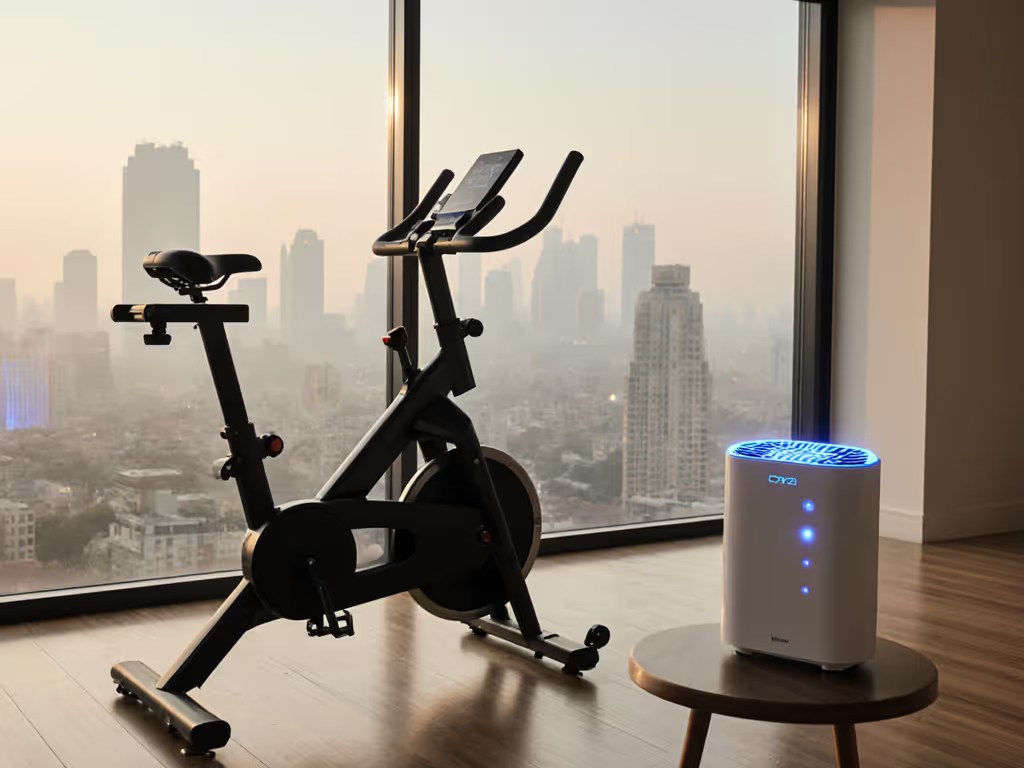
Not directly. An exercise bike cannot filter the air around you unless paired with a standalone air purifier unit.
Indoor cycling does shield you from acute street-level pollution (vehicle exhaust, construction dust, pollen concentrations at ground level). However, this benefit exists whether you ride an air bike or a magnetic flywheel bike (it is about being indoors, not about the bike itself).
If you are concerned about air quality while training indoors, the solution is environmental:
- Use a standalone HEPA or activated-carbon air purifier rated for your room's square footage.
- Position it to avoid turbulence from the bike's fan-based resistance.
- Check local air quality data (AQI) to assess whether indoor rides genuinely reduce your exposure compared to outdoor alternatives on low-pollution days.
What should I prioritize when choosing an exercise bike for an urban apartment?
For urban professionals in shared-wall homes, the hierarchy is:
-
Noise and vibration isolation: Measure actual decibel output during typical workouts. Under 75 dB is acceptable for early-morning use without waking neighbors or family. Insist on independent reviews that include calibrated sound measurements (not just "whisper quiet" marketing language).[1] Real-home testing reveals what marketing omits.
-
Power and cadence accuracy: If you are syncing to training apps (TrainerRoad, Zwift, Apple Fitness+), verify the bike supports Bluetooth FTMS or ANT+ FE-C. Confirm accuracy drift is documented in independent tests.[6] Accuracy within ±2% is a quantified threshold worth seeking.
-
Open connectivity: Avoid vendor lock-in. Bikes with Bluetooth and ANT+ dual-band support and offline functionality give you flexibility to switch apps without losing core features.
-
Durability and maintenance: Check warranty length and parts availability. Standard pedals (9/16''), replaceable seatposts, and accessible documentation reduce long-term cost of ownership.[1] A bike that is easy to service at home beats one requiring professional repair.
-
Footprint and floor protection: A stable base with integrated transport wheels matters in apartments where heavy, vibrating equipment can annoy downstairs neighbors or damage floors. For layout, vibration mats, and airflow tips tailored to small spaces, see our quiet home bike setup guide.
Should I buy a fan-based air bike or a magnetic flywheel bike?
This depends on your workout goals and environment:
| Criterion | Air Bike | Magnetic Flywheel Bike |
|---|---|---|
| Resistance Type | Load-dependent (faster = harder)[2] | Adjustable via console |
| Noise Level | Typically elevated during hard efforts | Generally lower baseline |
| HIIT Suitability | Excellent (explosive power matches surge) | Good (preset resistance may lag) |
| Adjustment | Continuous; no discrete levels | Stepped or smooth via electronics |
| Cost | Often lower entry price | Often higher |
| Urban Apartment | Requires rigorous noise testing; fan noise may breach quiet hours | Better baseline for early morning |
| Maintenance | Fan bearings, blade alignment, lubrication[1] | Belt tension, magnet cooling |
Neither category includes integrated air filtration. The distinction is about resistance mechanism and acoustic signature.
What maintenance is needed to keep an exercise bike running quietly and accurately in an urban setting?
Maintenance directly impacts noise and accuracy:
Weekly:[1]
- Lubricate moving parts (chain, pedals) to reduce squeaks and grinding noise.
- Check chain/belt tension. Loose tension causes vibration and noise transmission to floors and walls.
- Inspect the fan (if equipped) for debris or blade misalignment, which amplifies noise.
Monthly:[1]
- Inspect the frame for cracks or flex (signs of structural compromise that increase vibration and noise).
- Examine bearings and joints for wear; lubricate or replace as needed to reduce mechanical noise.
- Test the display console and sensors. Accuracy drift often correlates with sensor misalignment or battery issues.
Annually:[1]
- Professional tune-up to catch issues that escape home maintenance (bottom bracket play, crank alignment, bearing preload).
Maintenance is not optional. A well-maintained bike is quieter and more accurate. A neglected one devolves into squeaks, rattle, and sensor unreliability, precisely what urban riders cannot afford. Use our exercise bike maintenance guide for step-by-step checklists tailored to home environments.
Are there any red flags in air filtration exercise bike marketing?
Yes. Watch for:
- "Filters urban pollution while you ride": no. Unless paired with a separate room purifier, a bike does not filter ambient air.
- "Whisper quiet" without dB specifications: meaningless. Insist on measured noise data. "Quiet" is subjective; decibels are not.
- "Unlimited air filtration" used to describe air resistance: this conflates air resistance (the bike's mechanism) with air purification (an environmental feature the bike does not have).[2]
- Warranties shorter than 2 years: insufficient for a piece of fitness equipment.[4] For fine-print differences and real claim outcomes, see our exercise bike warranty comparison. Commercial-grade air bikes typically offer 2-5 years, signaling durability confidence.
- No mention of connectivity standards (Bluetooth FTMS, ANT+ FE-C): a red flag for vendor lock-in. Open standards protect your data and app choices.
- Proprietary parts (non-standard pedals, custom seatposts, firmware-locked consoles): these increase long-term repair costs and limit multi-user flexibility.
What Should You Do Next
For urban riders concerned about air quality:
- Do not expect a bike to filter pollution. Buy a standalone air purifier if indoor air quality is a priority, and size it for your room's square footage.
- Choose an exercise bike based on noise, accuracy, and durability, not marketing claims about air filtration.
- Verify noise levels yourself using independent tests or long-term user reviews that include real decibel data.
- Prioritize open connectivity (Bluetooth FTMS / ANT+ FE-C) to avoid vendor lock-in and app dependence.
- Request a detailed maintenance schedule and parts pricing before purchase. This reveals true cost of ownership.
For apartment dwellers: Research how a specific model performs in shared-wall homes. Unit showrooms and manufacturer specs often omit real-world noise signatures. Seek reviews from users who have trained early morning and survived downstairs neighbor feedback.
For data-conscious riders: Test any new bike's power and cadence accuracy against a known reference (a power meter on an outdoor bike, for example) during the return window. Accuracy drift over time is common; baseline testing gives you a reference to track degradation.
Quiet is a performance feature.
The path forward is clear: buy a quiet, accurate, open-standard-compatible exercise bike. Do not wait for a mythical "air filtration bike." Control what you can: noise isolation, maintenance discipline, app flexibility, and informed selection. That is progress. Everything else is marketing.
Related Articles