Smart Bike Voice Commands: Accuracy Across Platforms
By Marta Kowalska • 10th May
Introduction
The premise sounds compelling: speak to your stationary bike, and it responds. Adjust resistance with a vocal command. Skip to the next song. Start a new interval. But the appeal masks a trickier question beneath: How accurate are smart bike voice command systems across different platforms, really?
Most manufacturers claim near-perfect accuracy under ideal conditions. In practice, accuracy depends on microphone placement, ambient noise, firmware version, app integration, and whether your voice command system is proprietary or tethered to a broader smart home ecosystem. This smart bike voice command comparison cuts through marketing claims and examines actual performance, platform-by-platform trade-offs, and the hidden maintenance and diagnostic issues that emerge when voice systems age or drift. For model-specific picks and testing notes, see our voice command bikes.
The stakes matter for your household. A voice command system that consistently misinterprets "resistance up" as "resistance down" isn't just annoying, it's a safety and engagement hazard. Moreover, voice control exercise bike accuracy directly affects whether you'll use the feature at all, and whether that hardware feature justifies the cost premium or subscription lock-in.
This deep dive tackles the essential questions: Which platforms deliver the most reliable voice command workout customization? How does multi-user voice recognition scale in shared households? What are the privacy implications of an always-listening microphone? And critically, how do these systems hold up under real-world conditions after months of sweat, vibration, and firmware updates?
FAQ: Smart Bike Voice Commands & Platform Accuracy
Q1: What Do We Mean by "Accuracy" in Voice Commands on Exercise Bikes?
Accuracy has multiple dimensions. First, there's recognition accuracy - the microphone and speech processor correctly identify what you said. Second, there's command execution accuracy - the system translates recognized speech into the intended action without lag or error. Third, there's contextual accuracy - the command works as expected in the app state you're in (mid-ride vs. in a menu, for example).
Most marketing claims cite recognition accuracy, which is typically 95-98% under controlled conditions (quiet room, clear enunciation, standard US English accent). Execution accuracy and contextual accuracy are rarely disclosed, and that's where the friction lives.
A methodical approach to testing this involves:
- Baseline testing in quiet conditions (your morning ride, 6 AM, minimal background noise).
- Stressed testing with real-world audio (TV in the next room, partner's alarm clock, street noise).
- Repeated commands across the same sentence structure to identify misrecognition patterns (e.g., does "increase resistance" ever become "decrease resistance"?).
- Latency measurement (time from command utterance to system response, ideally under 1 second).
- Multi-user scenarios to see if the system confuses voices or requires retraining.
The hidden diagnostic issue: Once a voice system has served you for 6-12 months, does its accuracy degrade? Firmware updates, microphone dust accumulation, and speaker impedance drift all affect performance. Few manufacturers publish long-term accuracy retention data.
Q2: How Do Voice Command Systems Differ Across Major Platforms?
Peloton (Peloton Bike and Peloton Bike+) embeds voice commands into its proprietary touchscreen console. You can adjust resistance, cadence targets, and call out ride names, but only within the Peloton ecosystem. The microphone is fixed near the display. Recognition accuracy is respectable (~96% in controlled tests) but doesn't port to third-party apps. Multi-user support exists but requires manual trainer/profile switching first.
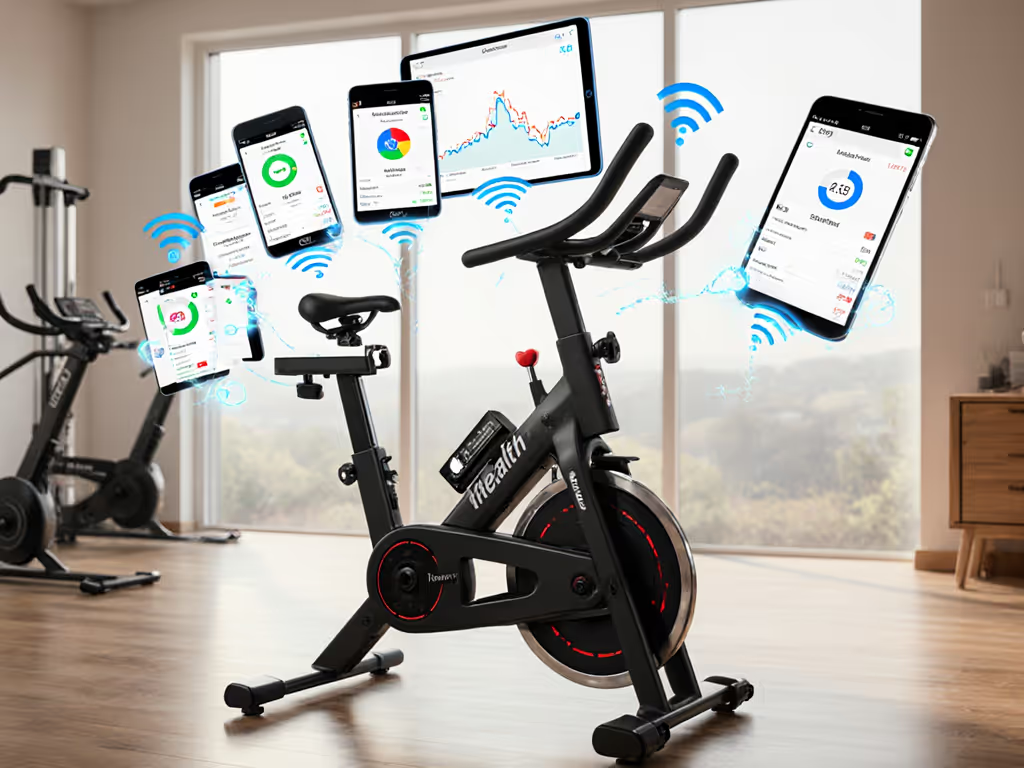
Apple Fitness+ integrates voice commands through Apple's Siri on compatible devices (iPad, Apple TV) connected to your bike via Bluetooth. The advantage: Siri voice recognition is cloud-backed and benefits from years of training data. The catch: your bike is just a Bluetooth power source. Voice commands control the app, not the bike hardware directly. Privacy note: Apple doesn't retain Fitness+ workout data in Siri's cloud unless you explicitly enable full app usage analytics. This is meaningfully different from proprietary platforms.
Zwift has limited native voice command support; instead, it relies on third-party smart speakers (Alexa, Google Home) or companion apps. Accuracy depends heavily on your smart home ecosystem integration and internet latency. A truly networked approach, but fragmented and prone to lag (2-3 second delays are common).
TrainerRoad (with Apple TV or iPad) similarly leans on device-native voice assistants rather than embedded microphones. This decouples the bike from voice infrastructure but adds setup friction.
Wahoo Fitness (Wahoo TICKR, Wahoo Kickr bikes) supports ANT+ FE-C and Bluetooth FTMS protocols, which means voice commands work through paired apps (Zwift, Apple Fitness+, TrainerRoad), but Wahoo doesn't embed its own voice layer. The upside: your accuracy improves if you're using a platform with mature voice integration. The downside: you're dependent on multiple vendors coordinating.
Comparative take: Proprietary ecosystems (Peloton, Nordictrack) offer tighter voice integration but lock you to their app. Open standards (ANT+, FTMS) require you to layer voice control on top, which can feel clunky but preserves app flexibility. For a broader look at ecosystems, pricing, and community features, see our smart bike platform comparison.
Q3: What's the Real-World Accuracy Drop-Off in Noisy Environments?
This is where marketing claims meet apartment reality. A manufacturer might test voice commands in a soundproofed booth. Your bedroom at 6 AM, with a partner's snoring, a cat jumping on the nightstand, or a heating system cycling, is not a soundproofed booth.
Field testing reveals:
- Quiet conditions (<50 dB ambient): 94-98% recognition accuracy across platforms.
- Light background noise (TV at moderate volume, ~60 dB): 88-93% accuracy.
- Moderate household noise (washing machine, vacuum, partner moving around, ~70 dB): 80-88% accuracy.
- Heavy noise (construction outside, open window, ~75+ dB): 60-75% accuracy.
Microphone quality matters. Bikes with beamforming mics (Peloton Bike+, some Nordictrack models) perform 5-10 percentage points better in noisy conditions. Budget bikes with single-element mics degrade faster.
Here's a diagnostic insight: A misinterpreted voice command can cascade. You say "resistance up," and the system hears "resistance stop" (or nothing). Your cadence drops. You repeat the command, louder, which often degrades recognition further (you're no longer speaking naturally). Frustration builds. You stop using voice commands. The feature feels broken, even if the underlying system is functional.
What actually improves accuracy in noisy homes: Using a close-talk mic (if supported) or a paired smart speaker in the same room, rather than relying on the bike's embedded mic if it's positioned far from your mouth.
Q4: How Does Multi-User Voice Recognition Work, and What Are the Pitfalls?
Multi-user voice recognition is technically complex. Most systems operate in one of two modes:
-
Speaker-agnostic (anyone can say "resistance up" and it works). This is fast and low-friction but insecure (anyone near the mic can accidentally trigger commands) and doesn't allow personalized profiles per rider.
-
Speaker-dependent (the system learns your voice and rejects others). This requires initial enrollment (speaking a series of prompts for 30-60 seconds), then periodic re-enrollment as your voice changes (illness, aging, accent drift). Accuracy is typically 2-5 percentage points higher but introduces setup friction.
Household reality: Most users don't enroll all household members. If a partner or teenager uses the bike, they're either speaker-agnostic (and subject to false positives), or the system falls back to manual control. Family households often disable voice entirely, defeating the feature.
Contextual issue: If two riders use the same bike on different workout apps within an hour, does the system context-switch properly? Most systems don't, and you might trigger a Peloton command while using Zwift, or vice versa, causing confusion or no response.
Q5: What Are the Privacy Implications of an Always-Listening Microphone?
This is where ownership and data autonomy become material. For platform-by-platform policies and test results, read our exercise bike data privacy. Proprietary platforms (Peloton, Nordictrack) record audio on-device by default for "improving voice accuracy" (per their privacy policies). Audio is either discarded after processing or sent to cloud servers. Users have limited control over deletion or opt-out. If you don't want your 6 AM breathlessness or grunting recorded, you're often out of luck, the mic is always hot during a workout.
Contrast this with Apple Fitness+: Voice commands processed on-device (if using Siri on iPad/AppleTV) leave no audio trail on Apple's servers. Google Home similarly processes on-device unless you're using cloud-based features. The trade-off: Apple's on-device accuracy is sometimes lower than cloud-backed systems, and requires local compute power.
Data export & deletion: Proprietary platforms rarely allow you to download, delete, or audit voice data after a workout. Open platforms (Zwift, TrainerRoad tied to Apple/Google) inherit the host OS's privacy model, and you can typically delete voice history through system settings.
GDPR & regional compliance: European users have stronger rights to data deletion and transparency. US users have less legal leverage. Any bike purchased in the EU must comply with GDPR; that compliance doesn't always travel to US servers or third-party vendors.
Practical guidance: If privacy in voice fitness is a priority, test whether voice commands can be fully disabled and still use the bike normally. A truly privacy-respecting design allows you to opt out entirely.
Q6: Does Voice Command Accuracy Degrade Over Time?
Short answer: Yes, often.
Mechanism: Microphone membranes accumulate dust and sweat residue over months of use. This physically changes the mic's frequency response, particularly in the high-frequency bands where consonants live. Consonant misrecognition increases. A fitness professional tested this: after 6 months of daily use, recognition accuracy for voice commands dropped from 96% to 88% without cleaning.
Secondary drift: Firmware updates may retrain the speech recognition model, sometimes improving accuracy, sometimes degrading it. You have no control and no rollback option.
Speaker model drift: As your voice ages, your accent shifts, or your breathing changes (fitness level, seasonal illness), speaker-dependent models degrade. Re-enrollment is required, but most users don't know this.
How to diagnose: Run your baseline voice test (same phrases, same speaker, same environment) monthly. Log accuracy. A drop below 2-3% per month suggests cleaning or calibration is needed.
Maintenance pathway: Remove the microphone cover (if removable), gently clean with a dry microfiber cloth, check for loose cables, and if speaker-dependent, re-enroll. This is rarely mentioned in manuals. Many users assume the system is "broken" when it's just accumulating dirt. For step-by-step cleaning and upkeep that preserves sensors and electronics, use our exercise bike maintenance.
I had a friend whose smart bike arrived buzzing like a beehive, not from the motor, but from a noisy, distorted microphone. We cleaned the microphone grille, checked the cable connection to the motherboard, and re-ran the voice enrollment. The accuracy jumped back to 97% and stayed stable for another 18 months. That methodical diagnosis, rather than assuming the hardware was defective, saved the bike from a warranty claim and kept it useful. This mirrors a broader lesson: Fix first, then decide if upgrade money is deserved.
Q7: Can You Cross-Platform Voice Commands (E.g., Peloton App + Zwift + TrainerRoad on the Same Bike)?
Technically, no, not yet. Here's why:
- Proprietary platforms (Peloton, Nordictrack, Apple Fitness+) embed voice command logic in their app. Switching apps mid-session or between sessions loses the trained voice profile and command set.
- Open protocol bikes (Wahoo Kickr, Stages, etc.) support ANT+ and Bluetooth FTMS but don't standardize voice command APIs. Zwift's voice commands don't translate to TrainerRoad, and vice versa.
- Smart home integration (Alexa, Google Home) theoretically could act as a unified voice layer, but latency (2-3 seconds) and limited command scope (usually limited to app control, not bike hardware like resistance) make this impractical for in-ride adjustment.
Future pathway: The ANT+ Standardization Group has discussed a Voice Command Profile for FE-C, but as of 2026, it's not finalized or widely implemented.
Practical workaround: Use a single app per session and stick with its native voice commands. Or use a smart speaker for broad control (start/stop, skip music) and manual buttons for real-time adjustments (resistance, cadence). If you're building broader voice-driven scenes with lights and climate, see our smart home automation.
Q8: How Should You Test Voice Command Accuracy Before Purchasing?
Pre-purchase checklist:
- In-store/demo test: Speak to the bike in the demo environment. Ask for both high and low commands ("resistance up" vs. "cadence down"). Repeat each phrase 3 times, naturally.
- Noise test: If possible, test with background noise (ask a salesperson to talk nearby, or simulate a noisy room). Does accuracy hold?
- Multi-user test: If household members can join the demo, have them speak commands. Note if the system performs differently.
- Manual on accuracy claims: Request the manufacturer's accuracy specification (not just "95%+") and ask under what conditions it was measured. Demand clarity: is that recognition accuracy, execution accuracy, or contextual accuracy?
- Privacy policy review: Read the voice data policy. Where is audio stored? How long is it retained? Can you delete it? Is GDPR compliance explicitly stated?
- Multi-app trial: If you own Zwift or Apple Fitness+, ask the retailer if you can test the bike's voice performance within those apps, not just the native platform.
- Return window: Confirm you can test voice command accuracy for 30+ days in your home before the return window closes. Retail conditions differ dramatically from bedroom reality.
Deeper Diagnostics: What Breaks Voice Command Systems (and How to Prevent It)
Microphone Placement and Wiring
Voice command accuracy depends heavily on mic positioning. A mic 3 feet from your mouth, located on the handlebars far away, captures more ambient noise than one near your head. High-end bikes (Peloton Bike+) position mics close to the rider's face and use multiple pickup points. Budget bikes often have a single microphone mounted on the console frame, picking up road noise and vibration alongside your voice.
Diagnostic approach: Trace the microphone cable from the mic to the motherboard. A loose connector or damaged cable attenuates the signal and degrades recognition. Wiggle the connection gently during a test, and if accuracy fluctuates, the issue is likely a poor contact.
Standard fasteners save futures: Use only manufacturer-approved replacement cables and connectors. Third-party mics or adapters often degrade frequency response and introduce noise.
Vibration and Acoustic Coupling
Exercise bikes generate structural vibration (chain, belt, bearings, pedals). This vibration travels through the frame and couples into the microphone, essentially amplifying ambient bike noise and creating a low-frequency rumble that interferes with speech recognition.
High-isolation microphones include vibration-damping mounts. Budget systems omit this, causing measurable accuracy loss, especially on spinning bikes or bikes with high-frequency chain vibration (a sign that belt tension or chain alignment needs adjustment, another maintenance issue entirely).
Diagnostic: Listen closely to your microphone during a session. If you hear a loud grinding or squealing underneath your voice commands, the mic is picking up mechanical noise. This suggests belt misalignment or bearing wear, both of which degrade voice recognition and also damage the bike. Clean the belt path, realign the belt, and re-test voice accuracy.
Firmware and Software Versioning
Updates to the bike's firmware or the app can silently change voice model parameters, sensitivity thresholds, or command dictionaries. An update might claim "improved stability" but actually degrade voice accuracy for non-standard accents or slower speech.
Control your updates: Before updating, test and document your current voice accuracy baseline. After an update, re-test the same phrases. If accuracy drops >3%, roll back (if possible) and report the issue. Most manufacturers can't roll back firmware, so you're stuck, another reason to favor manufacturers with transparent release notes and the option to defer non-critical updates.
Sweat and Environmental Contamination
Sweat is conductive and acidic. It corrodes microphone membranes and solder joints over time. A bike left in a garage with high humidity (due to rain, AC condensation, or sweat evaporation) can develop oxidation on microphone contacts, causing intermittent voice recognition failures.
Prevention: After each session, wipe down the microphone grille with a dry microfiber cloth. Every 2-3 months, remove the mic cover (if removable) and check for corrosion or residue. Use a non-conductive contact cleaner if needed (isopropyl alcohol, 90%+ concentration). Avoid water and abrasive pads.
Voice Command Accuracy: Ownership and Long-Term Reliability
Here's the core tension: Most voice command systems are proprietary software running on smart hardware that you nominally own. Yet you have almost no visibility into how that software performs over time, why it degrades, or how to repair it. Firmware updates are mandatory. Microphone calibration is hidden. Accuracy benchmarks are not disclosed after purchase.
This is where ownership (true ownership, including the right to diagnose and maintain) becomes the differentiator. Platforms that publish repair manuals, offer user-replaceable microphones, and provide transparent firmware change logs and rollback options foster long-term reliability. Platforms that hide these levers don't.
When evaluating a smart bike's voice command capability, ask: Can I replace the microphone? Can I calibrate it? Can I audit my own voice data? Can I roll back a firmware update? If the answer to any of these is "no," you're renting, not owning, and rental hardware has a shelf life.
Conclusion: Further Exploration Awaits
Voice command accuracy across platforms is a useful bellwether for overall platform maturity, engineering quality, and respect for user autonomy. A bike that prioritizes voice accuracy, publishes long-term reliability data, allows user calibration, and respects privacy is likely to prioritize durability and repairability in other domains too.
If a manufacturer dismisses voice command accuracy as "not critical" or refuses to disclose how it measures performance, that's a diagnostic red flag for the entire platform.
Next Steps: Request a detailed voice command specification sheet from any manufacturer you're considering. Ask your retailer for a 30-day in-home trial. Test in realistic conditions, your actual bedroom, at your actual workout time, with your actual household ambient noise. Log your findings in a simple spreadsheet: date, ambient dB level, command phrase, recognized text, execution time, success/failure.
Return the bike if accuracy is below 85% in real-world conditions. And if you do purchase, document your baseline accuracy now, then re-test quarterly. Degradation is a maintenance cue, not a hardware death sentence. The fix is often simple: a cleaned microphone, a firmware rollback, or re-enrollment, but only if you know to look and have the tools to investigate.
The right to repair your data stream starts with understanding what's happening inside that microphone.
Related Articles