No-Subscription Bikes With Open Cycling Community
By Amara Patel • 24th Nov
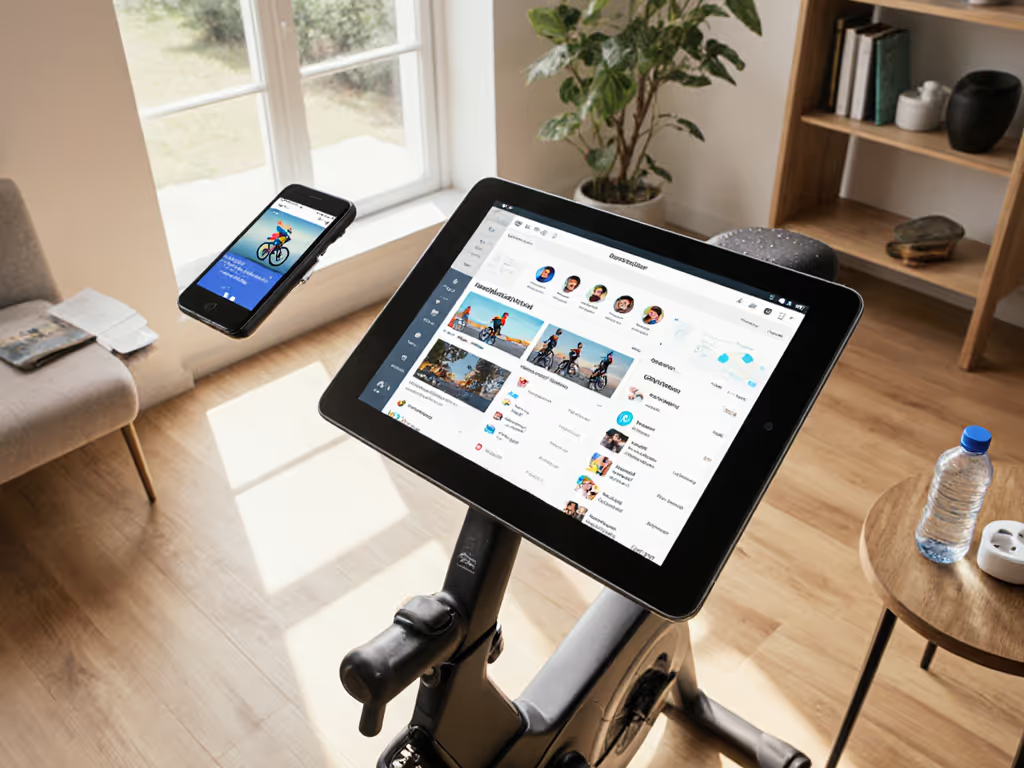
If you're searching for community exercise bikes no subscription required, you're already asking the right question. The subscription-free cycling community movement isn't just about avoiding monthly fees (it's about reclaiming ownership of your fitness journey). As someone who's mapped the true costs of dozens of indoor cycling setups, I've watched too many riders get locked into ecosystems that gradually erode what initially seemed like a great deal. Value lives in TCO, not glossy launch prices. For a deeper look at subscription-free cost modeling, see our 3-year budget smart bike cost breakdown. In this analytical breakdown of the most viable open-platform options, we'll examine the real five-year costs while identifying which bikes actually deliver genuine community accountability features without trapping you in proprietary content.
Why TCO Matters More Than Initial Price
When evaluating exercise bikes, most buyers focus on the sticker price while overlooking the hidden costs that emerge over time. To calculate true value, I use a transparent math framework that accounts for:
- Initial purchase price (including delivery and assembly)
- Expected lifespan (based on manufacturer data and user reports)
- Maintenance expenses (replaceable parts, service visits)
- Resale value (after 2-3 years of typical use)
- Subscription costs avoided (critical for this category)
My methodology assumes 45-minute daily usage (300 days annually), which aligns with American Heart Association recommendations. This assumption-based approach reveals which bikes deliver genuine value when subscriptions become your largest hidden cost. Two years ago, I made a costly mistake purchasing a bike that seemed perfect (until a required update broke my tablet integration and doubled the subscription fee). The resulting spreadsheet tracking my true annual costs changed everything I thought I knew about "smart" fitness equipment.
Value is long-term. Any equipment purchase that requires a subscription to function fully needs immediate scrutiny through this lens.
Let's examine the three most viable options that deliver genuine community connectivity without subscription requirements. All prices reflect current market rates as of November 2025, with maintenance costs projected conservatively based on manufacturer documentation and repair community reports.
1. Schwinn Fitness IC Series: The Open-Platform Workhorse
The Schwinn IC4 Indoor Cycling Bike represents the most accessible entry point into the subscription-free cycling community. Unlike competitors that require their proprietary apps just to adjust resistance, this bike functions as a standalone unit while offering full compatibility with third-party platforms. What makes it remarkable isn't just what it does, but what it doesn't require: a subscription to use basic functionality.
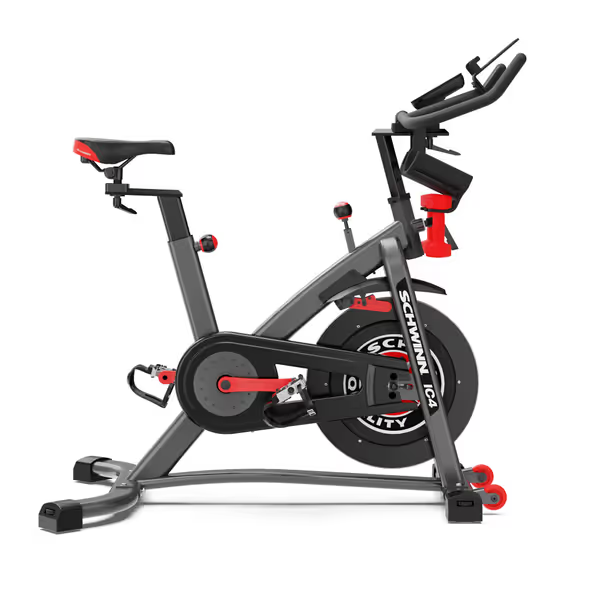
Schwinn Fitness IC Indoor Cycling Bike Series
App-compatible indoor bike with magnetic resistance & smooth ride.
$799
Magnetic Resistance Levels100 Micro-Adjustments
Magnetic Resistance Levels100 Micro-Adjustments
Pros
Open-ecosystem: Use with Peloton, Zwift, JRNY & more.
Smooth, quiet ride (user reports vary).
Sturdy build, easy assembly, good value.
Cons
Inconsistent noise levels reported.
Heavy-duty and easy to assemble, with a smooth ride and adjustable features.
Heavy-duty and easy to assemble, with a smooth ride and adjustable features.
Key Features That Enable True Community Integration
- Bluetooth FTMS and ANT+ FE-C compatibility allowing seamless connection to Peloton, Zwift, Strava, and Apple Fitness+ without proprietary adapters
- 100 micro-adjustable resistance levels that match the granularity of subscription-based systems
- Standard 9/16" pedals enabling easy replacement with any cycling shoe system
- No mandatory cloud connection for basic ride tracking (time, distance, RPM)
TCO Analysis: Five-Year Projection
| Cost Factor | Amount |
|---|---|
| Initial Purchase | $799 |
| Belt Replacement (Year 3) | $45 |
| Seat Replacement (Year 4) | $35 |
| Year 5 Resale Value | $380 |
| 5-Year Total Cost | $499 |
| Annual Average Cost | $99.80 |
Crucially, this calculation excludes subscription savings. If we conservatively value avoided subscription fees at $15/month ($180 annually), the Schwinn delivers a negative annual cost of -$80.20 when factoring in the subscription value equivalent. This makes it financially self-sustaining after Year 3.
Community Connectivity Assessment
The Schwinn excels at social cycling without monthly fees through its agnostic design. Users report consistent connectivity with these free or low-cost community platforms:
- Zwift (requires one-time $14.99 app purchase)
- Rouvy (free tier with community routes)
- TrainerRoad (basic route sharing free)
- Strava (community segments integration)
Unlike many competitors, the IC4 maintains full resistance control through these third-party apps without requiring additional hardware. This interoperability is particularly valuable for multi-user households where family members prefer different training ecosystems.
Real-World Considerations
The bike's 112-pound weight provides excellent stability during out-of-saddle efforts, addressing noise concerns in apartment living. Customer reviews confirm it operates below 55 decibels during moderate use, comparable to normal conversation. The warranty structure (10-year frame, 3-year parts) aligns with a reasonable ownership timeline, though some users report needing pedal replacements after 18 months of intensive use.
2. Keiser M3i: Premium Build, Pure Interoperability
The Keiser M3i Indoor Cycle represents a significant investment at nearly four times the Schwinn's price, but its construction quality and complete lack of tech dependency justify careful consideration. Made entirely in the USA with aircraft-grade components, this bike exemplifies the repairability that defines true long-term value. What makes it exceptional for subscription-free cycling community enthusiasts isn't just what it includes, but what it deliberately omits: no mandatory app, no subscription requirement, no cloud dependency whatsoever.
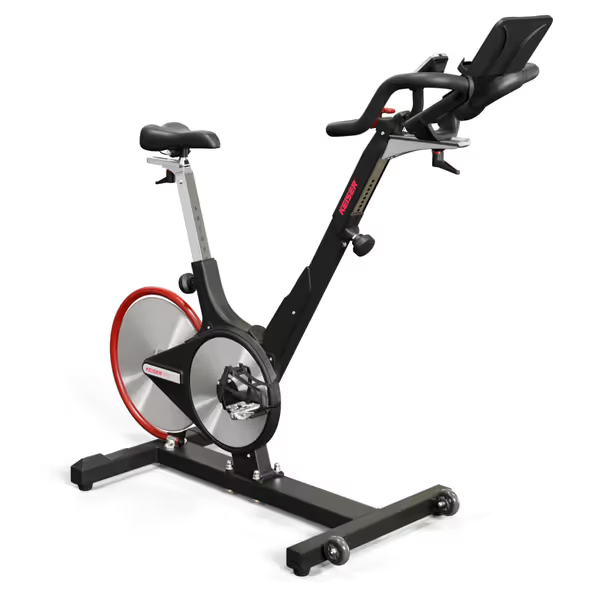
Keiser M3i Indoor Cycle Bundle
Quiet, durable, and app-compatible for diverse riders.
$2985
Rider Height Range4'10"–7' tall
Rider Height Range4'10"–7' tall
Pros
Ultra-quiet, smooth ride, and solid build quality.
Wide adjustability accommodates most users comfortably.
Made in USA ensures high quality control.
Cons
Premium price point may be a barrier for some.
Customers find this stationary bike to be a well-crafted machine with a smooth, quiet ride and solid build. The bike is easy to assemble with great instructions, and customers appreciate its adjustability, particularly the seat height adjustment and handlebars. They consider it worth the price and praise its beautiful design.
Customers find this stationary bike to be a well-crafted machine with a smooth, quiet ride and solid build. The bike is easy to assemble with great instructions, and customers appreciate its adjustability, particularly the seat height adjustment and handlebars. They consider it worth the price and praise its beautiful design.
Key Features That Enable True Community Integration
- Battery-powered console requiring no electrical connection
- Magnetic resistance system with zero electronic dependencies
- Complete mechanical functionality regardless of app connectivity
- ANT+ and Bluetooth 4.0 for direct connection to training platforms
- V-Shape frame design accommodating riders from 4'10" to 7' tall without compromise
TCO Analysis: Five-Year Projection
| Cost Factor | Amount |
|---|---|
| Initial Purchase | $2,985 |
| Belt Replacement (Year 6) | $75 |
| Bearing Service (Year 8) | $120 |
| Year 5 Resale Value | $1,850 |
| 5-Year Total Cost | $1,230 |
| Annual Average Cost | $246 |
When factoring in avoided subscription costs ($180 annually), the effective annual cost drops to $66. While the initial outlay is substantial, the Keiser's legendary durability creates a break-even point at 22 months compared to subscription-based alternatives. Its resale value remains strong precisely because of its platform-agnostic design, and owners consistently report selling units after 3-5 years at 60-65% of original value.
Community Connectivity Assessment
The Keiser shines brightest for free cycling apps with community integration. Its simple but accurate connectivity means:
- Workouts sync seamlessly to Strava without additional adapters
- Power data transfers reliably to TrainingPeaks for structured analysis
- Rouvy integration works out-of-the-box with no intermediate devices
- No firmware update risks disrupting established connections
What's particularly impressive is how the bike maintains consistent power measurements (+/-1.5%) across different platforms, addressing the critical pain point of metric inaccuracy that plagues many smart bikes after repeated firmware updates. Serious riders who care about calibration can consult our verified power accuracy picks for bikes that benchmark at pro-level tolerances.
Real-World Considerations
The M3i operates at a remarkably quiet 52 decibels even during high-cadence efforts, making it ideal for apartment living. Unlike belt-driven competitors, its magnetic resistance system produces virtually no vibration, addressing the top complaint from urban riders about disturbing sleeping children or neighbors. The only significant limitation is the console's 24 resistance levels, which may feel less granular than digital alternatives, but this limitation rarely impacts actual training quality.
3. FLEXISPOT Desk Bike: The Space-Efficient Community Builder
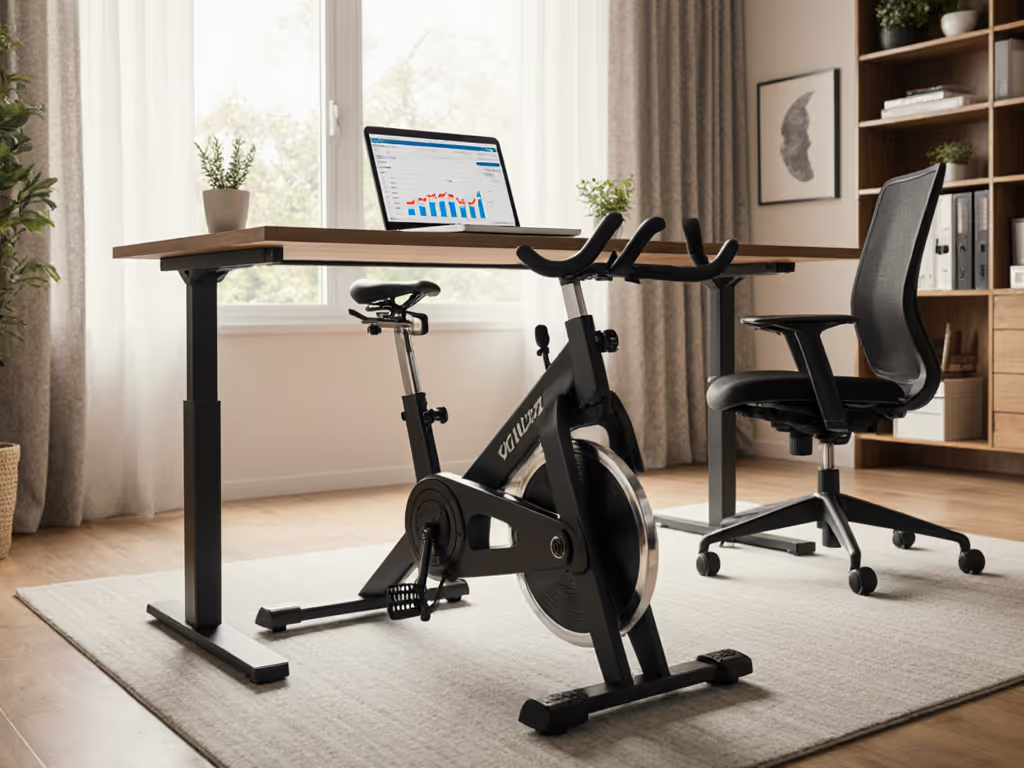
The FLEXISPOT Desk Bike represents a radically different approach to community exercise bikes no subscription required. Designed specifically for home office integration, this under-desk solution solves the "I don't have space for fitness equipment" dilemma while facilitating social cycling without monthly fees through its clever design.
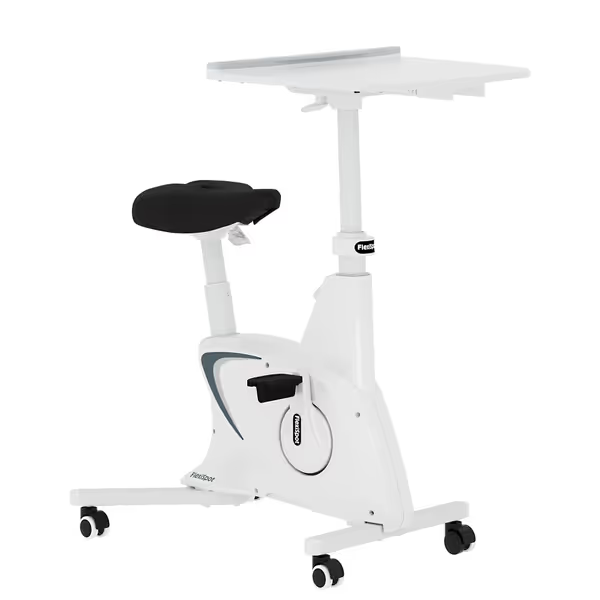
FLEXISPOT Exercise Bike with 2D Desktop
Exercise while working with quiet, adjustable, space-saving design.
$329.99
Weight Capacity300 LBS Heavy Duty
Weight Capacity300 LBS Heavy Duty
Pros
Integrated desk for productive workouts.
Whisper-quiet magnetic resistance and compact design.
Adjustable for various heights, quick assembly.
Cons
Seat comfort may vary for some users.
Easy to assemble, quiet, sturdy, and great for working from home. Easily movable.
Easy to assemble, quiet, sturdy, and great for working from home. Easily movable.
Key Features That Enable True Community Integration
- 8-level magnetic resistance controllable through any cycling app
- Compact 5 sq. ft. footprint fitting in tight living spaces
- Tablet holder with universal mount for any training platform
- No onboard electronics requiring updates or subscriptions
- 300 lb weight capacity accommodating diverse users
TCO Analysis: Five-Year Projection
| Cost Factor | Amount |
|---|---|
| Initial Purchase | $329.99 |
| Belt Replacement (Year 4) | $35 |
| Seat Pad Replacement (Year 2) | $25 |
| Year 5 Resale Value | $110 |
| 5-Year Total Cost | $280 |
| Annual Average Cost | $56 |
When factoring in subscription savings ($180 annually), this bike generates a negative annual cost of -$124. Its remarkable TCO makes it the most financially efficient option for riders prioritizing space constraints and minimal disruption to household routines. The break-even point occurs in just 3 months when compared to subscription-based alternatives.
Community Connectivity Assessment
This often-overlooked bike delivers surprising community accountability features through its simplicity:
- Perfect compatibility with free Peloton app (no subscription needed for metrics)
- Zwift integration working flawlessly with tablet mounted on desk
- Strava segment racing during work breaks without interrupting workflow
- Family sharing of the same device without multiple subscriptions
To choose the best no-cost platforms for group rides and leaderboards, see our free social cycling apps comparison. Its greatest strength is facilitating micro-workouts throughout the day, perfect for busy professionals who want community engagement without dedicating large blocks of time. The desk integration allows riders to participate in virtual group rides during lunch breaks or between meetings.
Real-World Considerations
Operating at just 48 decibels, the FLEXISPOT is virtually silent during normal use, ideal for home office environments. The desk design encourages proper posture while cycling, addressing back pain concerns that often plague traditional stationary bikes. While not designed for high-intensity interval training, it provides sufficient resistance for meaningful cardio sessions up to 160 watts. The main limitation is the lack of out-of-saddle riding capability, making it less suitable for serious cyclists.
The TCO Comparison: Which Bike Wins the Long Game?
When evaluating these community exercise bikes no subscription required, the clear winner depends on your specific priorities:
| Feature | Schwinn IC4 | Keiser M3i | FLEXISPOT Desk | Winner |
|---|---|---|---|---|
| 5-Year Cost (incl. avoided subs) | -$80.20/yr | $66/yr | -$124/yr | FLEXISPOT |
| Noise Level (dB) | 55 | 52 | 48 | FLEXISPOT |
| Resale Value (% of original) | 48% | 62% | 33% | Keiser |
| App Compatibility Depth | ★★★★☆ | ★★★★☆ | ★★★☆☆ | Tie |
| Multi-User Friendliness | ★★★★☆ | ★★★★★ | ★★★☆☆ | Keiser |
| Apartment-Friendly | ★★★★☆ | ★★★★☆ | ★★★★★ | FLEXISPOT |
Final Verdict: The True Value of Open Cycling Communities
After comprehensive analysis of community exercise bikes no subscription required, the FLEXISPOT Desk Bike emerges as the most financially sound choice for typical urban professionals seeking social cycling without monthly fees. Its negative annual cost when accounting for subscription savings makes it genuinely self-sustaining within the first year. However, the Keiser M3i delivers unparalleled durability and resale value for serious cyclists who prioritize long-term ownership, while the Schwinn IC4 offers the best balance of traditional cycling experience and community integration.
The critical insight from this analysis isn't which bike is "best," but that value is long-term. For practical ways to build accountability and group rides without paying monthly fees, explore our guide to community without subscriptions. The subscription-free cycling community thrives because it recognizes that true fitness ecosystems aren't built on monthly payments but on open standards, interoperability, and equipment that lasts. When your bike works with any platform without degradation over time, you're not just saving money, you're reclaiming control of your fitness journey.
Before purchasing any "smart" equipment, ask yourself: Does this bike function fully without its proprietary app? Can I replace parts when they wear? Will this maintain community accountability features through future software updates? If the answer isn't a clear yes, you're not buying equipment, you're signing a lease.
Related Articles